


This article was written in collaboration with our partner Leisure Domus, a smart luxury rental brand offering houses, rooms, and curated stays, sharing tips on culture and how to experience Italy like a local.
[Segue la versione in italiano]
Thinking that a city with more than two thousand years of history could possibly be free of a darker side would be rather naive. The truth is that Rome has seen its fair share of unsettling stories over the centuries, and mysterious places can still be found all across the city.
From ancient prisons and churches to ossuaries and catacombs, some of these places preserve very tangible traces of their past. Others have inspired stories of ghosts, alchemists, devils and unexplained presences for centuries. And then there are places that need no legend at all to feel slightly unsettling: knowing their history — or, in some cases, simply looking at them — is more than enough.
We have rounded up some of Rome’s creepiest and most mysterious places, bringing together historical facts, traditions and legends that still form part of the darker side of the Eternal City.
Sommario
- Church of the Sacred Heart of Suffrage and the Museum of the Souls in Purgatory
- Capuchin Crypt
- Church of Santa Maria dell’Orazione e Morte
- Non-Catholic Cemetery
- The Catacombs of Rome
- Mamertine Prison
- Former Santa Maria della Pietà Psychiatric Hospital
- Mastro Titta’s House
- Castel Sant’Angelo
- Torre degli Annibaldi
- The Magic Gate in Piazza Vittorio
- Palazzo Zuccari
- The Devil’s Chair
- Chiesa del Sacro Cuore del Suffragio e Museo delle Anime del Purgatorio
- Cripta dei Frati Cappuccini
- Chiesa di Santa Maria dell’Orazione e Morte
- Cimitero Acattolico di Piramide
- Le catacombe di Roma
- Carcere Mamertino
- Ex manicomio di Santa Maria della Pietà
- Casa di Mastro Titta
- Castel Sant’Angelo
- Torre degli Annibaldi
- Porta Magica di Piazza Vittorio
- Palazzo Zuccari
- Sedia del Diavolo
Church of the Sacred Heart of Suffrage and the Museum of the Souls in Purgatory
Seen from the Lungotevere, the Church of the Sacred Heart of Suffrage looks almost out of place. With its spires, pinnacles and Neo-Gothic façade, it does indeed resemble a miniature Milan Cathedral. But this unusual similarity is only the beginning. Inside, the Museum of the Souls in Purgatory might put even the most convinced sceptic to the test. This small collection was assembled between the late 19th and early 20th centuries around the belief that the dead could leave physical traces of their presence behind.
It all began in 1897, when a fire broke out in the church chapel. Father Victor Jouët, the French missionary behind the construction of the building, believed he could make out a human face among the marks left by the flames on the wall. From that moment on, he began travelling across Europe collecting objects whose owners claimed they bore traces left by the souls of the dead: books, fabrics, wooden tablets and garments marked with dark imprints, often resembling hands or fingers.
The museum still preserves these objects today. Of course, there is no evidence that the marks have a supernatural origin — but then again, who are we to say otherwise? That is precisely what makes the collection so fascinating. Rather than a museum of ghosts, it is a collection of real objects around which stories of apparitions and contact with the dead have developed, offering a glimpse into a time when the boundaries between faith, death and everyday life were perceived very differently from today.
Capuchin Crypt
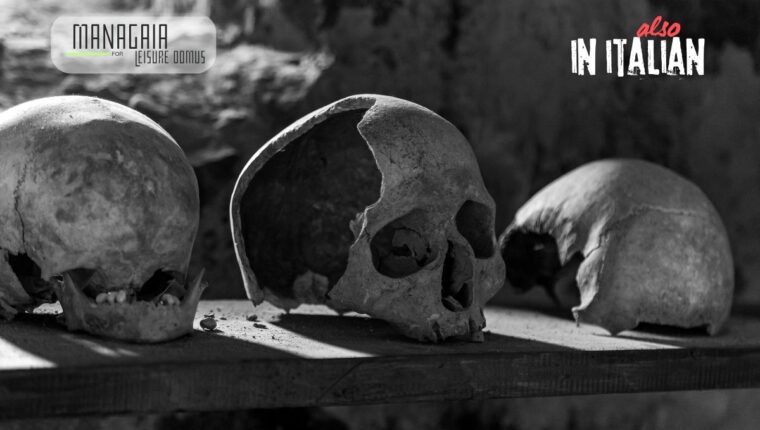
On Via Veneto, beneath the Church of Santa Maria della Concezione, you will find chandeliers, arches, rosettes and floral decorations. Nothing particularly unusual there — except for one tiny detail: they are made from human vertebrae, femurs, pelvises and skulls.
The Capuchin Museum and Crypt contains the remains of around 3,700 people, most of them Capuchin friars. The bones are arranged across six rooms, including the Crypt of the Skulls, the Crypt of the Pelvises and the Crypt of the Leg Bones and Thigh Bones. We do not know exactly who conceived the arrangement. Sources from 1732 still describe simple piles of bones, while in 1775 the Marquis de Sade wrote about the elaborate decorations during his travels in Rome. The arrangement we see today must therefore have taken shape over the course of the 18th century.
Although the effect may seem deliberately macabre to modern visitors, its original meaning was quite different. In Capuchin spirituality, the crypt served as a memento mori, a reminder of the fleeting nature of earthly life and the promise of resurrection.
Church of Santa Maria dell’Orazione e Morte
This time, death is right there in the name. The Church of Santa Maria dell’Orazione e Morte, on Via Giulia, is associated with a confraternity that for centuries took responsibility for recovering and burying the bodies of people no one had claimed.
These were mainly bodies found in the Roman countryside or pulled from the Tiber, people otherwise destined to disappear without a funeral or a grave. The confraternity held funeral rites for them and buried them in its own cemetery, which once stretched behind the church towards the river. The burial ground disappeared at the end of the 19th century during the construction of the Tiber embankments.
Death is also an integral part of the building itself. Skulls, skeletons and funerary symbols decorate the façade, while the crypt still contains human bones arranged to form crosses, chandeliers and other ornamental features.
Non-Catholic Cemetery
Personally, this is one of my favourite places in Rome. The word cemetery might suggest something rather different, yet here death seems to lose much of its gloom. Surrounded by cypress trees, greenery, sculptures and monumental graves, the Non-Catholic Cemetery feels secluded, peaceful and, I would say, almost poetic.
Its history begins in Papal Rome, when not everyone could be buried in Catholic cemeteries. Protestants and members of other faiths had to be buried elsewhere, and from the early 18th century one such burial ground was established beside the Pyramid of Cestius. The Non-Catholic Cemetery has been in use since at least 1716, when permission was granted for members of the exiled Stuart court to be buried there. Over time, it became the resting place of people from many different countries and religious backgrounds. Today, almost four thousand people are buried here, including John Keats, Percy Bysshe Shelley, Antonio Gramsci and Andrea Camilleri.
The Catacombs of Rome
There is more to Rome than the city we see above ground. Beneath it lies another one, made up of tunnels, niches, burial chambers and kilometres of underground galleries, used during the first centuries AD primarily by Christian communities and, in some cases, Jewish ones.
Admittedly, referring simply to the Catacombs of Rome is rather broad, as the name encompasses dozens of different complexes. Among the best known are San Callisto, Priscilla, Domitilla, San Sebastiano and Sant’Agnese. The Catacombs of San Callisto, which began to develop along the Appian Way in the late 2nd century, became one of the main cemeteries of the Roman Church and contained the tombs of numerous popes and martyrs. The Catacombs of Priscilla also housed papal tombs and burials associated with Rome’s earliest Christian communities.
So why have we included them among Rome’s most unsettling places? The answer lies mainly in their structure: narrow, repetitive underground corridors, walls lined with rows of burial niches and chambers opening into the darkness. Forget the popular image of secret hideouts where Christians lived to escape persecution: these were, first and foremost, vast underground burial grounds. Feeling slightly uneasy now?
Mamertine Prison
Only a few metres separate the Roman Forum from one of the darkest places in ancient Rome. The Carcer Tullianum, better known as the Mamertine Prison, was Rome’s state prison and was used to hold some of the city’s most important enemies as they awaited death.
The complex consists of two chambers, one above the other. The lower chamber, the Tullianum, is the oldest: a cramped underground space where prisoners such as Jugurtha and Vercingetorix were held. Sources record executions by strangulation and decapitation. Positioned directly in front of the political heart of the city, the prison also served as a very visible warning of Roman justice.
But documented history is only part of the story. According to Christian tradition, Saints Peter and Paul were imprisoned here before their martyrdom. One story claims that Peter struck his head against the wall while being led into the prison, leaving an imprint in the stone. He is then said to have miraculously caused a spring to emerge inside the Tullianum, using its water to baptise his jailers, Processus and Martinianus, after their conversion to Christianity.
History and legend almost seem to overlap here. And even if you remove the apostles, miracles and mysterious marks in the stone, what remains is an underground cell where some of Rome’s most famous enemies waited to be put to death.
Former Santa Maria della Pietà Psychiatric Hospital
Behind the unsettling atmosphere of the former Santa Maria della Pietà psychiatric hospital lies a very real history of isolation and suffering within an institution that separated thousands of people from the rest of society for decades.
The Monte Mario complex opened in 1914. It was designed almost as a self-contained town, covering 150 hectares and comprising 43 buildings, including 29 patient pavilions, a church, kitchens, a laundry and workshops. It was originally intended to accommodate around one thousand people, but by the years following the First World War, the number of patients had risen to roughly three times that figure.
For decades, thousands of people lived here cut off from the rest of the city — and not necessarily because they had what would today be recognised as a psychiatric condition. One of the saddest chapters in the history of Italian psychiatric institutions concerns people who were committed because they were considered socially problematic or simply failed to conform to the norms of their time. The medical records preserved in the historical archive still tell the stories of men and women who spent years behind these walls.
The 1978 Basaglia Law began the process of dismantling Italy’s psychiatric hospital system, and Santa Maria della Pietà finally closed as a psychiatric hospital in December 1999. Today, the complex has once again become part of the city and is also home to the Museo Laboratorio della Mente, a museum dedicated to the history and experience of mental health care.
Mastro Titta’s House
Mastro Titta’s House is a small building in Rome’s Borgo district. Its name refers to Giovanni Battista Bugatti, the executioner of the Papal States.
Bugatti worked as an executioner from 1796 to 1864 and meticulously recorded the executions he carried out over a career spanning almost seventy years. The total stands at 514 executions.
There is, however, one important detail concerning the exact location of his home. Tradition identifies it with the decorated building at 4 Vicolo del Campanile, but studies of the building’s history have called this theory into question. Bugatti may actually have lived in the neighbouring house, on the corner of the former Borgo Nuovo. A small mystery surrounding the most famous executioner of Papal Rome.
Castel Sant’Angelo
First a mausoleum, then a fortress, a papal residence and finally a prison. A magnificent building with a very dark history.
Its cells held figures including Benvenuto Cellini, Giordano Bruno, Beatrice Cenci, Giuseppe Francesco Borri and Cagliostro. Some prisoners died inside the fortress, while others were taken to nearby Piazza di Ponte for execution.
One cell in particular had an especially sinister reputation, a terrible and much-feared place. The Sammalo, or San Marocco, is said to have been so cramped that a prisoner lowered inside could neither stand upright nor lie down.
Is it really surprising, then, that a place like this should also have inspired ghost stories? The most famous is that of Beatrice Cenci, who was beheaded in 1599 after being convicted, along with other members of her family, of murdering her father Francesco. According to one Roman legend, on the night between 10 and 11 September her ghost returns to the area around Ponte Sant’Angelo carrying her own severed head.
Torre degli Annibaldi
A short walk from the Colosseum stands a severe, imposing medieval tower built in the 13th century by the powerful Annibaldi family. Its very construction became a source of conflict with the rival Frangipani family, who are said to have tried to disrupt the works by hurling arrows and stones from their own stronghold at the Colosseum.
But that is not the part of its history that earned it a place on this list. According to tradition, at the foot of the Torre degli Annibaldi, beneath the Capitoline Wolf that once stood there, the severed hands of thieves caught stealing from churches were put on public display. A fairly effective way of making it clear what would happen to the next thief.
The Magic Gate in Piazza Vittorio
In the middle of the gardens of Piazza Vittorio stands a walled-up doorway that leads absolutely nowhere. It is all that remains of Villa Palombara, the 17th-century residence of Marquis Massimiliano Palombara, an aristocrat with a keen interest in alchemy and esotericism. Built in the second half of the 17th century, the Magic Gate is covered in symbols, formulas and alchemical inscriptions.
The documented history more or less ends there. Then comes the considerably more entertaining part.
According to legend, in 1680 a mysterious guest at the villa — identified as the physician and alchemist Giuseppe Francesco Borri — spent a night in the garden searching for a herb capable of turning metals into gold. By the following morning, however, he had vanished. In his place, there were supposedly traces of gold and sheets of paper covered in incomprehensible formulas. Unable to decipher them, Palombara is said to have had the symbols engraved on the gate in the hope that someone, someday, would solve the mystery.
The villa disappeared during the urban redevelopment of the Esquilino district. The gate, on the other hand, survived — and it still leads nowhere.
Palazzo Zuccari
Just a few steps from Trinità dei Monti, an enormous open mouth appears ready to swallow anyone walking along Via Gregoriana. This is the entrance to Palazzo Zuccari, also known, for fairly obvious reasons, as the House of Monsters.
The Mannerist painter Federico Zuccari began building his home and studio here around 1590, imagining it as more than a private residence. He also intended it to become a place dedicated to artists and their training. Unsurprisingly, what makes the building impossible to miss are the enormous grotesque faces framing its doors and windows on Via Gregoriana. The main entrance quite literally sits inside the gaping jaws of a monster and is now used as an entrance to the Bibliotheca Hertziana.
We were particularly literal with this one: no ghosts, no curses. Palazzo Zuccari makes the list of Rome’s most unsettling places for a much simpler reason. To get inside, you have to walk straight through a monster’s mouth.
The Devil’s Chair
In Piazza Elio Callistio stands a Roman ruin whose nickname has been far more famous than the name of its supposed owner for centuries. The Devil’s Chair, or Tomb of Elio Callistio, is actually an ancient Roman funerary monument traditionally attributed to Elio Callistio, a freedman of Emperor Hadrian.
Its demonic nickname came much later. After the façade collapsed, what remained of the building vaguely resembled a gigantic armchair. That was apparently enough for people in the Middle Ages to begin regarding it as the Devil’s throne.
The people who took shelter among the ruins probably helped make its reputation even darker. At night, they would light fires which, seen from a distance, must have created quite an eerie sight. Stories of demonic presences and magical practices gradually grew around the monument. By the 14th century, some people were writing wishes on its walls, while others scraped pieces from its bricks to use in potions.
The archaeological explanation is considerably less infernal: it was simply a tomb.
__________________________
Questo articolo è stato realizzato in collaborazione con il nostro partner Leisure Domus, un brand di ospitalità smart luxury che propone case, camere e soggiorni selezionati, condividendo consigli sulla cultura italiana e su come vivere l’Italia in modo autentico.
13 luoghi di Roma con una storia decisamente inquietante
Pensare che con duemila anni di storia alle spalle Roma non abbia anche un lato oscuro è piuttosto ingenuo. La verità è che di storie inquietanti se ne sono succedute parecchie e sono tantissimi i luoghi misteriosi sparsi in giro per la città.
Tra prigioni e chiese antiche, ossari e catacombe, alcuni di questi luoghi conservano tracce molto concrete del proprio passato. Altri hanno alimentato nei secoli racconti di fantasmi, alchimisti, diavoli e presenze difficili da spiegare. E poi ci sono posti che non hanno bisogno di nessuna leggenda per mettere un po’ di inquietudine: basta conoscerne la storia o, in certi casi, basta semplicemente guardarli.
Abbiamo raccolto alcuni dei luoghi più spaventosi e misteriosi di Roma, mescolando fatti storici, tradizioni e leggende che ancora oggi fanno parte del lato più oscuro della Capitale.
Chiesa del Sacro Cuore del Suffragio e Museo delle Anime del Purgatorio
A guardarla dal Lungotevere, la Chiesa del Sacro Cuore del Suffragio sembra quasi fuori posto. Sì, perché con le sue guglie, i pinnacoli e la facciata neogotica sembra effettivamente un piccolo Duomo di Milano. Ma le curiosità non si fermano a questa insolita somiglianza: all’interno, il Museo delle Anime del Purgatorio potrebbe mettere alla prova anche lo scettico più convinto. Si tratta di una piccola raccolta nata tra la fine dell’Ottocento e l’inizio del Novecento attorno all’idea che i defunti potessero lasciare tracce materiali del proprio passaggio.
Tutto cominciò nel 1897, quando un incendio divampò nella cappella della chiesa. Padre Victor Jouët, missionario francese che aveva voluto la costruzione dell’edificio, credette di riconoscere, tra i segni lasciati dalle fiamme sul muro, l’immagine di un volto umano. Da quel momento iniziò a viaggiare per l’Europa raccogliendo oggetti che, secondo i loro proprietari, portavano i segni lasciati dalle anime dei morti: libri, tessuti, tavolette e indumenti con impronte scure, spesso simili a mani o dita.
Il museo li conserva ancora oggi. Certo, non esiste alcuna prova che quelle impronte abbiano un’origine soprannaturale, ma in fondo chi siamo noi per metterlo in dubbio? La parte interessante sta proprio qui: più che un museo di fantasmi, è una raccolta di oggetti reali attorno ai quali sono nate storie di apparizioni e contatti con i defunti, testimonianza di un’epoca in cui il confine tra fede, morte e vita quotidiana era percepito in modo molto diverso dal nostro.
Cripta dei Frati Cappuccini
Su via Veneto, sotto la chiesa di Santa Maria della Concezione, ci sono lampadari, archi, rosoni e decorazioni floreali. Tutto regolare, certo, a parte per un piccolissimo dettaglio: sono fatti di vertebre, femori, bacini e teschi umani.
Il Museo e Cripta dei Cappuccini conserva i resti di circa 3.700 persone, in gran parte frati cappuccini. Le ossa sono distribuite in sei ambienti, tra cui la Cripta dei Teschi, quella dei Bacini e quella delle Tibie e dei Femori. Non sappiamo con certezza chi abbia concepito l’allestimento: nel 1732 le fonti descrivevano ancora semplici accumuli di ossa, mentre nel 1775 il marchese de Sade raccontò le decorazioni durante il suo viaggio a Roma. L’apparato che vediamo oggi deve quindi aver preso forma nel corso del Settecento.
Se oggi l’effetto può sembrare deliberatamente macabro, l’intenzione originaria era ben diversa. Nella spiritualità cappuccina, questo luogo rappresenta un memento mori, un modo per ricordare la precarietà della vita terrena e la prospettiva della resurrezione.
Chiesa di Santa Maria dell’Orazione e Morte
Stavolta il riferimento al trapasso è ben evidente direttamente nel nome di questo luogo sacro. La Chiesa di Santa Maria dell’Orazione e Morte, su via Giulia, è legata alla confraternita che per secoli si occupò di recuperare e dare sepoltura ai morti che nessuno reclamava.
Erano soprattutto cadaveri trovati nelle campagne romane o ripescati dal Tevere, persone destinate a scomparire senza un funerale e senza una tomba. La confraternita celebrava le esequie e li seppelliva nel proprio cimitero, un’area che si estendeva dietro la chiesa verso il fiume e che venne eliminata alla fine dell’Ottocento durante la costruzione dei muraglioni del Tevere.
La morte è parte integrante dell’architettura stessa dell’edificio: teschi, scheletri e simboli funerari decorano la facciata, mentre nella cripta sono ancora conservate ossa umane utilizzate per comporre croci, lampadari e altri elementi ornamentali.
Cimitero Acattolico di Piramide
Personalmente, è uno dei luoghi che preferisco della città. La parola cimitero potrebbe suggerire tutt’altro, e invece qui la morte sembra perdere buona parte della sua cupezza. Tra cipressi, vegetazione, sculture e tombe monumentali, il Cimitero Acattolico ha qualcosa di raccolto, silenzioso, direi quasi poetico.
La sua storia inizia nella Roma pontificia: all’epoca, non tutti potevano essere sepolti nei cimiteri cattolici. Protestanti e appartenenti ad altre confessioni dovevano trovare posto altrove e, dall’inizio del Settecento, uno di questi luoghi fu individuato accanto alla Piramide Cestia. Il Non-Catholic Cemetery è utilizzato almeno dal 1716, quando venne concessa la possibilità di seppellire nell’area alcuni membri della corte degli Stuart in esilio. Con il tempo il cimitero accolse persone provenienti da molti Paesi e appartenenti a confessioni diverse. Oggi vi riposano quasi quattromila persone, tra cui John Keats, Percy Bysshe Shelley, Antonio Gramsci e Andrea Camilleri.
Le catacombe di Roma
Non c’è solo la Roma che si vede in superficie. Sotto la città, ne esiste un’altra fatta di cunicoli, nicchie, camere funerarie, chilometri di gallerie scavate nel terreno, utilizzate nei primi secoli dopo Cristo soprattutto dalle comunità cristiane e, in alcuni casi, ebraiche.
Qui, forse, rimaniamo un po’ troppo generici quando parliamo di catacombe di Roma, perché mettiamo insieme decine di complessi diversi. Tra quelli più conosciuti ci sono San Callisto, Priscilla, Domitilla, San Sebastiano e Sant’Agnese. Quelle di San Callisto, che si sono sviluppate a partire dalla fine del II secolo lungo la via Appia, divennero uno dei principali cimiteri della Chiesa romana e accolsero le sepolture di numerosi pontefici e martiri. Anche le Catacombe di Priscilla ospitarono tombe papali e sepolture legate alle prime comunità cristiane.
Perché le classifichiamo tra i luoghi più inquietanti di Roma? La ragione sta soprattutto nella loro struttura: corridoi sotterranei stretti e ripetitivi, pareti occupate da file di loculi e camere che si aprono nel buio. Altro che nascondigli segreti in cui i cristiani vivevano per sfuggire alle persecuzioni, come vuole un certo immaginario popolare: erano prima di tutto enormi spazi funerari scavati sotto terra. Un po’ di inquietudine ora ce l’avete anche voi?
Carcere Mamertino
Pochi metri separano il Foro Romano da uno dei luoghi più cupi della Roma antica. Il Carcer Tullianum era la prigione di Stato destinata anche ai grandi nemici di Roma in attesa della morte.
Il complesso è formato da due ambienti sovrapposti. Quello inferiore, il Tullianum, è il più antico: un ambiente sotterraneo angusto nel quale finirono personaggi come Giugurta e Vercingetorige. Le fonti ricordano esecuzioni per strangolamento o decapitazione: il carcere, infatti, collocato significativamente davanti al centro politico della città, funzionava anche come monito visibile della giustizia romana.
Ma non c’è solo la storia documentata. Secondo la tradizione cristiana, proprio qui sarebbero stati imprigionati Pietro e Paolo prima del martirio. Si racconta che Pietro, mentre veniva condotto nella prigione, avesse battuto la testa contro la parete lasciando un’impronta nella pietra. Nel Tullianum avrebbe poi fatto sgorgare miracolosamente una sorgente con cui battezzare i carcerieri Processo e Martiniano, convertiti al Cristianesimo.
Realtà e leggenda finiscono quasi per sovrapporsi. E anche eliminando Apostoli, miracoli e impronte nella roccia, rimane una cella sotterranea nella quale alcuni dei più celebri nemici di Roma aspettarono di essere messi a morte.
Ex manicomio di Santa Maria della Pietà
Dietro l’atmosfera inquietante del manicomio di Santa Maria della Pietà c’è soprattutto una storia reale, fatta di isolamento e sofferenza dentro un’istituzione che per decenni ha separato migliaia di persone dal resto della società.
Il complesso di Monte Mario venne inaugurato nel 1914. Era stato pensato quasi come una città autonoma: 150 ettari complessivi, 43 edifici, 29 padiglioni destinati alla degenza, una chiesa, cucine, lavanderia e laboratori. La capienza prevista era di circa mille persone, ma già dopo la Prima guerra mondiale il numero dei ricoverati arrivò a essere circa tre volte superiore.
Per decenni migliaia di persone vissero qui separate dal resto della città. E non necessariamente perché affette da una patologia psichiatrica secondo i criteri attuali. Una pagina tristissima della storia dei manicomi italiani riguarda anche persone internate perché considerate socialmente problematiche o semplicemente fuori dalle norme del proprio tempo. Le cartelle conservate nell’archivio storico raccontano ancora oggi le vite di uomini e donne rimasti per anni dietro quelle mura.
La legge Basaglia del 1978 avviò il superamento del sistema manicomiale; il Santa Maria della Pietà chiuse definitivamente come ospedale psichiatrico nel dicembre 1999. Oggi il complesso è tornato a essere uno spazio della città e ospita anche il Museo Laboratorio della Mente.
Casa di Mastro Titta
La Casa di Mastro Titta è un piccolo edificio situato nel rione Borgo. Il nome rimanda a Giovanni Battista Bugatti, il boia dello Stato Pontificio.
Bugatti esercitò dal 1796 al 1864 e nei suoi registri annotò scrupolosamente le esecuzioni compiute durante una carriera durata quasi settant’anni: il conteggio arriva a 514 condanne eseguite.
C’è però un dettaglio importante relativo alla precisa collocazione della sua casa: la tradizione la identifica nella casa decorata di Vicolo del Campanile 4, ma gli studi sulla storia dell’edificio hanno messo in discussione questa teoria. Bugatti avrebbe abitato in realtà nella casa adiacente, all’angolo con l’antico Borgo Nuovo. Un piccolo enigma collegato al boia più famoso della Roma papalina.
Castel Sant’Angelo
Prima mausoleo, poi fortezza, residenza papale e infine prigione. Un edificio meraviglioso con una storia oscura.
Le sue celle ospitarono personaggi come Benvenuto Cellini, Giordano Bruno, Beatrice Cenci, Giuseppe Francesco Borri e Cagliostro. Alcuni detenuti morirono all’interno della fortezza, mentre altri vennero condotti all’esecuzione nella vicina Piazza di Ponte.
In particolare, esisteva una cella dalla fama particolarmente sinistra, un luogo terribile e temutissimo: sembrerebbe infatti che il Sammalo, o San Marocco, fosse talmente angusto che il prigioniero, calato al suo interno, non riuscisse a stare né in piedi né sdraiato.
Vi stupisce quindi che a un posto simile siano state associate anche storie di fantasmi? La più celebre è quella di Beatrice Cenci, decapitata nel 1599 dopo essere stata condannata insieme ad altri membri della famiglia per l’assassinio del padre Francesco. Secondo una delle leggende romane, nella notte tra il 10 e l’11 settembre il suo fantasma tornerebbe nei pressi di Ponte Sant’Angelo portando con sé la propria testa.
Torre degli Annibaldi
A pochi passi dal Colosseo sopravvive una torre medievale severa e massiccia, costruita nel Duecento dalla potente famiglia degli Annibaldi. La sua stessa edificazione fu motivo di scontro con i Frangipane, famiglia rivale che avrebbe cercato di ostacolare i lavori lanciando frecce e pietre dalla propria fortificazione sul Colosseo.
Ma non è questa parte della sua storia ad averle fatto guadagnare un posto nell’elenco. Secondo una tradizione, ai piedi della Torre degli Annibaldi, sotto la Lupa Capitolina che all’epoca si trovava in quel luogo, venivano esposte le mani mozzate dei ladri sorpresi a rubare nelle chiese. Un sistema piuttosto efficace per rendere chiaro cosa sarebbe successo al ladro successivo.
Porta Magica di Piazza Vittorio
Nel mezzo dei giardini di Piazza Vittorio c’è una porta murata che non conduce da nessuna parte. È ciò che rimane di Villa Palombara, la residenza seicentesca del marchese Massimiliano Palombara, aristocratico con un forte interesse per l’alchimia e l’esoterismo. La Porta Magica, costruita nella seconda metà del Seicento, è ricoperta di simboli, formule, iscrizioni alchemiche.
La storia documentata finisce più o meno qui. Poi comincia la parte decisamente più divertente.
Secondo la leggenda, nel 1680 un misterioso ospite della villa — identificato con il medico e alchimista Giuseppe Francesco Borri — trascorse una notte nel giardino cercando un’erba capace di trasformare i metalli in oro. Il mattino seguente, però, era scomparso. Al suo posto sarebbero rimaste alcune tracce d’oro e dei fogli coperti da formule incomprensibili. Palombara, incapace di decifrarle, avrebbe fatto incidere quei simboli sulla porta nella speranza che qualcuno, prima o poi, riuscisse a risolvere il mistero.
La villa è scomparsa durante le trasformazioni urbanistiche dell’Esquilino. La porta, invece, è rimasta, pur non portando ancora da nessuna parte.
Palazzo Zuccari
A due passi da Trinità dei Monti, una gigantesca bocca spalancata sembra pronta a inghiottire chi passa per via Gregoriana. È l’ingresso di Palazzo Zuccari, conosciuto non a caso anche come Casa dei Mostri.
Il pittore manierista Federico Zuccari iniziò a costruire qui la propria casa-studio intorno al 1590, immaginandola come qualcosa di più di una semplice abitazione: nelle sue intenzioni avrebbe dovuto diventare anche un luogo dedicato agli artisti e alla formazione. Neanche a dirlo, a renderla inconfondibile sono i giganteschi mascheroni che incorniciano porte e finestre su via Gregoriana. L’ingresso principale coincide letteralmente con le fauci spalancate di un mostro, oggi utilizzate come accesso alla Bibliotheca Hertziana.
Qui siamo stati particolarmente didascalici: niente fantasmi né maledizioni. Palazzo Zuccari rientra tra i posti più inquietanti di Roma per un motivo molto più semplice. Per entrare bisogna passare dentro la bocca di un mostro.
Sedia del Diavolo
In Piazza Elio Callistio c’è un rudere romano che per secoli ha avuto un nome decisamente più famoso di quello del suo proprietario. La Sedia del Diavolo (Sepolcro di Elio Callistio) è in realtà un monumento funerario romano, tradizionalmente attribuito a Elio Callistio, liberto dell’imperatore Adriano.
Il soprannome demoniaco nacque molto più tardi, quando, dopo il crollo della facciata, ciò che restava dell’edificio assunse vagamente la forma di una gigantesca sedia con i braccioli. Tanto bastò perché nel Medioevo cominciasse a essere considerata il trono del Diavolo.
A rendere la fama di questo posto sempre più oscura contribuivano probabilmente le persone che trovavano riparo tra le rovine, perché durante la notte accendevano dei fuochi che, visti da lontano, facevano un certo effetto. Intorno al monumento nacquero così racconti di presenze demoniache e pratiche magiche. Nel Trecento c’era chi scriveva desideri sulle pareti e chi raschiava pezzi dei mattoni per utilizzarli nella preparazione di pozioni.
La spiegazione archeologica è molto meno infernale: era semplicemente una tomba.


